
by Amy Harrison
Hae Sung: What if this is a past life as well, and we are already something else to each other in our next life? Who do you think we are then?
– Past Lives
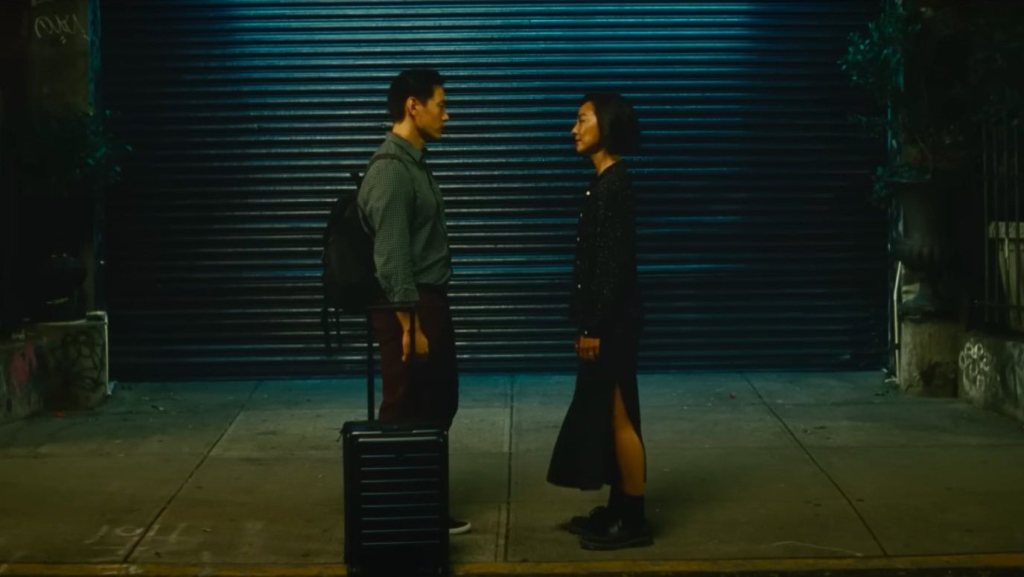
Past Lives tackles one of the hardest things we experience in life: having an unfulfilled love.
Screenwriter Celine Song showcases this in a beautifully raw way, drawing from her own personal experience to shape the entire story. The film opens with Na-young (Greta Lee) sitting in a bar with her childhood lover, Hae-sung (Teo Yoo), and her husband, Arthur (John Magaro). What connects the three is in-yun 인연 – the Korean concept that invisible threads of fate connect people across past and future lives. According to this philosophy, every encounter between two individuals in the present is a continuation of connections formed in previous lifetimes, making every meeting significant, no matter how brief.
The film follows the lives of Na-young and Hae-sung, showing how their paths diverge but remain quietly intertwined. We see their innocent love as 12-year-olds, until Na-young moves away. They reconnect online in their twenties, imagining what a relationship between them might look like, but the distance makes it impossible. Na-young comes to terms with this and moves on – meeting Arthur and falling in love. But, when Hae-sung visits her after decades apart, they’re faced with the question of whether they could have shared a life together, and they confront what might have been – and what still lingers.
What I love about Past Lives is that it suggests that some people are meant to ass through our lives, even if only for a brief time, and that love can be real and profound, even if it’s never fully lived out. It gives you hope that if you have met someone in this life with whom you share a sort of strange, otherworldly, and special connection – but timing, circumstances, or life itself got in the way – then perhaps, in another life, you’ll get to experience that connection fully, for everything it was meant to be.
Past Lives deals very interestingly with chance and fate. Chance is explored through the characters’ missed and unexpected opportunities – Na-young’s family moving away, their reconnection online, Na-young meeting Arthur, and Hae-sung’s eventual visit. All these events feel random, but through the lens of in-yun, they feel like steps along a path their relationship was always meant to take in this life. On the other hand, you can feel fate constantly hovering in the background. It leaves us asking whether their bond exists because of something deeper, even if that connection never fully becomes a romantic relationship in this life.
What I really think is that this film is emotional torture – it shows that you can feel deeply connected to someone and still realise you cannot be with them in this lifetime. And that is devastating. It probably explains why I cry every single time I watch it. But it’s such a real film, and after watching it I fully believed in in-yun. I started to think about the people I feel deeply connected to in my own life and realised that those bonds exist across my past and future lives, in different forms – hence, I got in-yun tattooed as a reminder of the invisible bonds which shape us.
We want this issue to make you think deeply about chance and fate – question your entire existence, relationships, and the way the universe seems to bring people and events into your life when you least expect it. Existential, I know. But, if we don’t think about these things, then how can we ever understand the subtle forces shaping our lives?
인연
This article was first published in Diceroll Magazine Issue One: Chance and Fate (May 2025).


